Introducing OpenAI Frontier: The Revolutionary Artificial Intelligence Platform
Estimated reading time: 7 minutes
Key Points
- OpenAI Frontier is the most advanced enterprise platform for AI agent management and orchestration [source].
- Facilitates integration of custom agents with existing enterprise systems: from CRM and ERP to internal applications.
- Offers persistent memory, data analytics, file management, and code execution in local, cloud, or OpenAI-hosted environments [more details].
- Includes tools for security, governance, and observability tailored to regulated industries.
- Integrates natively with production-ready AI agents and supports in-house and third-party developments.
- Launched alongside GPT-5.3-Codex, boosting code generation and enterprise automation [see announcement].
- Has prominent clients and partners like HP, Oracle, Uber, and other global industry leaders [examples].
Table of Contents
What is OpenAI Frontier?
OpenAI Frontier is the new enterprise artificial intelligence platform unveiled on February 5, 2026 [official announcement]. This platform was developed to bridge the gap between the power of AI models and their practical use in businesses, enabling the creation, deployment, and operation of AI agents as digital collaborators.
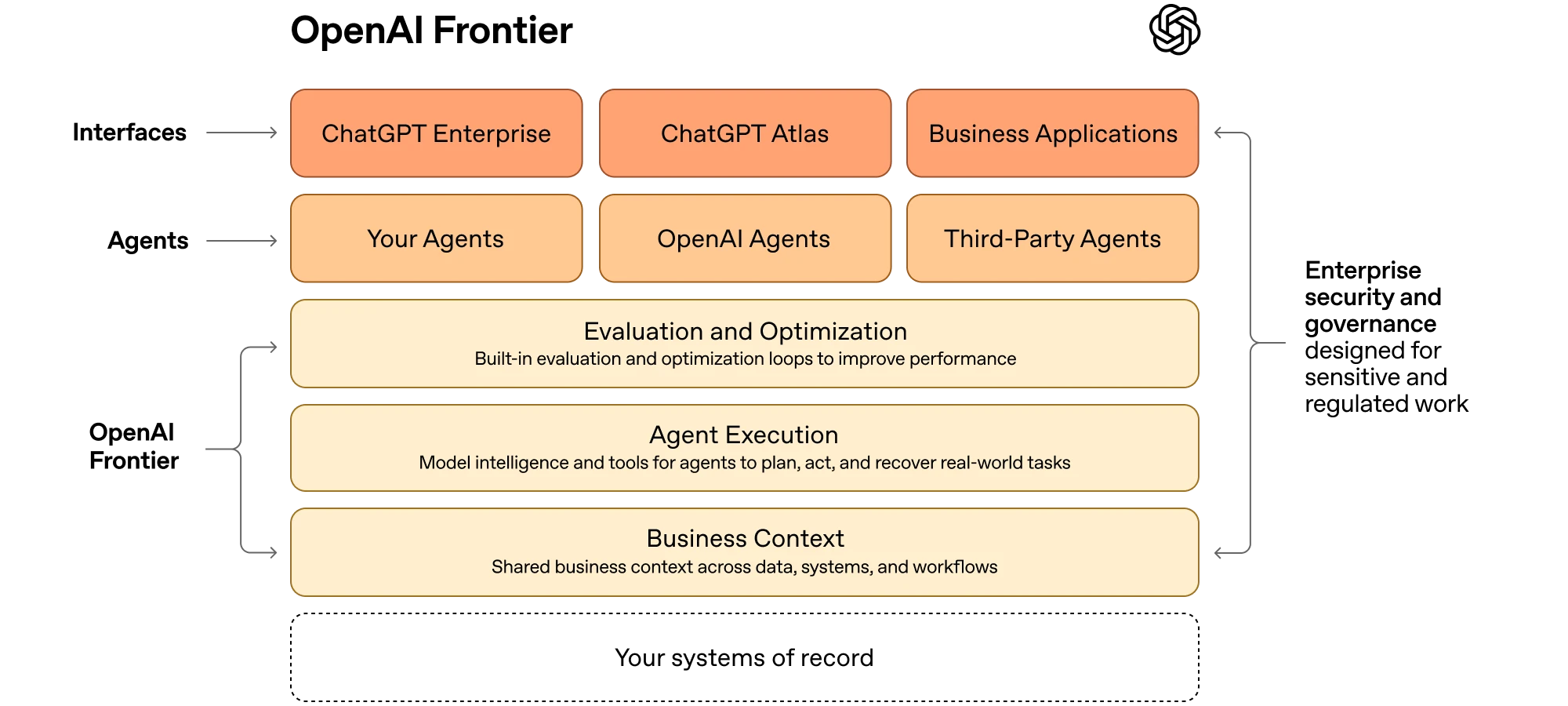
These enterprise agents can manage complex tasks like data analysis, customer support, and workflow automation. Frontier enables agents to learn from interactions, acquire persistent memory, and access shared business contexts, extracting information from data warehouses, ERP, and other sources [read more].
Key Platform Features
- Connectors and semantic layer for easy integration with existing systems without replacements, using open standards like the Context Model (more info).
- Multi-environment: deployment of agents locally, in the cloud, or on OpenAI infrastructure, allowing flexibility and low latency [details].
- Observability and optimization tools: log analysis and visualizations to audit behavior and performance of enterprise agents.
- Security and governance with granular management of identities, permissions, and workflows, ideal for regulated sectors ([source]).
- Human assistance: OpenAI engineers help with implementation, best practices, and customization of integrations and interfaces [more details].
- Compatibility with third-party and custom agents through ChatGPT, workflows, and business applications (recommended guide).
One of the differentiating points is the persistent memory and learning capability of agents, a crucial topic to transform AI effectiveness in long-term business processes.
Enterprise Applications and Use Cases
The breadth of OpenAI Frontier applications is astonishing. From major tech companies like HP, Intuit, or Oracle that already collaborate as users and partners [see use cases], to sectors such as manufacturing, energy, banking, and telecommunications.
- Operations optimization: automation of recurring processes, predictive analysis, and scenario simulation to reduce costs and accelerate results.
- Customer support and contact centers: deployment of agents in call centers for 24/7 service and personalized responses based on internal knowledge [example].
- Data management and analysis: automatic extraction of insights on enterprise data flows.
- Resource optimization in manufacturing and energy: risk prediction, loss reduction, and capacity simulation to maximize return on investment.
Advanced Models and Agent Orchestration
Along with the platform, OpenAI introduced GPT-5.3-Codex, a model specialized in code generation and automation [model detail]. This allows agents not only to interpret and execute tasks but also to create integrations, scripts, and custom automation flows.
The full orchestration covers real-time updates and monitoring, SDK integration, and additional services for reliable and scalable operations.
The offering is complemented by tools like ChatGPT Enterprise, Agent SDK, and AutoGPT to maximize intelligent automation in enterprise environments.
The Frontier Ecosystem and Competition
OpenAI does not operate alone. Frontier integrates and competes simultaneously with other advanced ecosystems, such as the Microsoft Agent Framework and Google Agentspace, platforms that also address large-scale intelligent automation.
This collaborative and competitive approach is driving global adoption of AI agents as digital coworkers, prepared to scale and transform critical areas of modern enterprises.
Frequently Asked Questions
What differentiates OpenAI Frontier from other enterprise AI platforms?
OpenAI Frontier offers native agent orchestration, persistent memory, simple integration, and priority access to the latest models like GPT-5.3-Codex, all in one environment.
Can I use my own agents alongside OpenAI’s?
Yes, deployment of own and third-party agents is possible, integrating them with ChatGPT and customizing for specific business tasks.
Which sectors can benefit from OpenAI Frontier?
Sectors like banking, manufacturing, energy, healthcare, communications, and technology are already implementing Frontier agents for automation and advanced analytics.
Where can I learn more about creating custom agents?
Check out our complete guide on OpenAI Agent, with detailed information for companies of all sizes.
Will OpenAI Frontier replace human work?
Frontier is designed to enhance human-AI collaboration, automating repetitive tasks and allowing employees to focus on high-value work. The goal is to create true digital work companions.