Advancing Toward the Future: OpenAI Frontier
Estimated reading time: 7 minutes
Key Points
- OpenAI Frontier is an enterprise platform that enables the creation and management of AI agents for automating critical workflows and advanced connectivity with existing systems.
- It stands out for its integration of business context and the institutional memory created by AI agents – learn about the role of memory in AI.
- It offers observability and granular control over tasks and identities, with full auditing – see our references on Microsoft Agent Framework.
- The platform operates across multiple environments (on-premises, clouds, hosted by OpenAI) and is accessed from popular tools like ChatGPT – discover real cases of ChatGPT in agent mode.
- Frontier includes on-site engineers from OpenAI as part of the customized deployment and has been tested with global pioneering clients.
Table of Contents
- Introduction: The Leap Toward Advanced Enterprise AI
- Integration of Business Context and Organizational Memory
- Creation, Organization, and Execution of Intelligent Agents
- Observability, Control, and Identity in Frontier
- Clients, Use Cases, and Custom Deployment
- Infrastructure and Integration Flexibility
- Commercial Impact and Business Transformation
- Frequently Asked Questions
Introduction: The Leap Toward Advanced Enterprise AI
*Buckle up: we are moving toward the future of AI with OpenAI Frontier*. This platform aims to automate fundamental processes in organizations and close the gap between the potential of AI models and their actual adoption in business (Source: Tech Target).
Launched in early 2026, Frontier represents OpenAI’s movement towards deployable artificial intelligence, spanning from agent management to tailored customization within each company.
Integration of Business Context and Organizational Memory
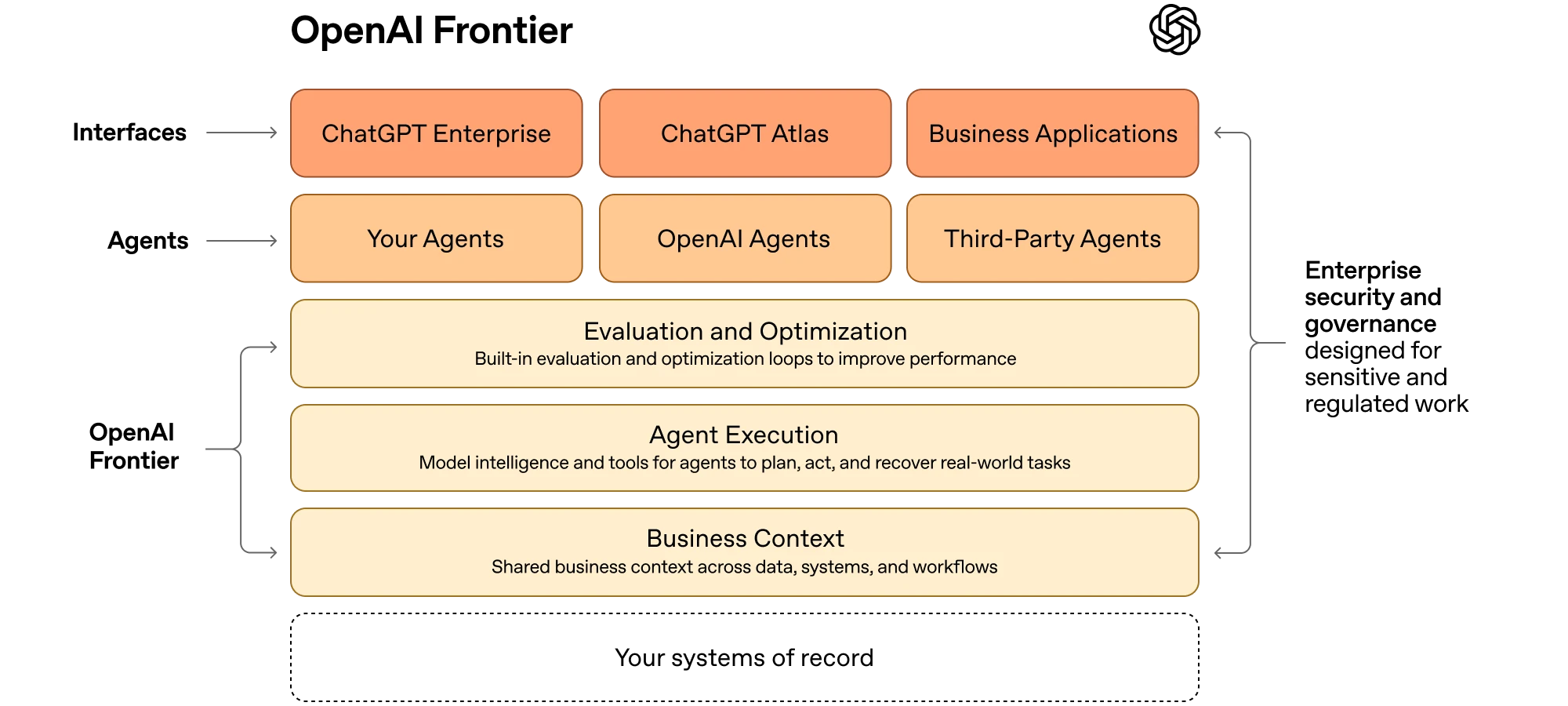
One of Frontier’s differentiating leaps is the direct connection with enterprise systems, such as CRM tools, data warehouses, and internal applications (Source: OpenAI). The agents created access critical business information, collecting and building a living “institutional memory” over time.
Deepen your understanding of the importance of memory in AI by reading this specialized article.
Creation, Organization, and Execution of Intelligent Agents
Frontier excels by allowing users to create AI agents from a conversational interface similar to ChatGPT (Source: SiliconAngle). Just describe the task in natural language and the platform takes care of creating, deploying, and operating the agent.
Agents can handle files, run code, analyze data, and integrate with existing tools (Source: HelpNetSecurity). For a detailed breakdown, visit the guide on AI agents explained.
“The platform provides an open and reliable execution environment where agents learn and adapt with each interaction.”
Observability, Control, and Identity in Frontier
Frontier incorporates an audit log that tracks every action and enables evaluating quality metrics such as accuracy and politeness (Source: SiliconAngle). Additionally, it introduces strict identity and permission controls (HelpNetSecurity).
Discover how these control challenges are addressed in similar platforms in the updates of Microsoft Agent Framework.
Clients, Use Cases, and Custom Deployment
OpenAI is already working with industry pioneers such as HP, Intuit, Oracle, State Farm, Thermo Fisher, and Uber (Source: Tech Target). Additionally, the list includes clients like BBVA, Cisco, T-Mobile, and technology partners like Clay Labs and Ambience Healthcare (Source: SiliconAngle).
Documented applications range from disaster prediction and mitigation to accelerating call center services through AI. Explore real cases and examples of Frontier.
A differentiating point: OpenAI engineers work directly within organizations to customize Frontier integration (Tech Target).
Infrastructure and Integration Flexibility
Frontier can operate on existing infrastructure (on-premises, cloud, OpenAI). It does not require replacing previous systems: its design is flexible and non-invasive, and agents can be accessed via ChatGPT, workflows like Atlas, and enterprise applications (Source: HelpNetSecurity).
Highlights include support for the Model Context Protocol and tools like AgentKit.
Learn about real cases of ChatGPT in agent mode, and explore Frontier’s relation with AutoGPT as emerging technologies.
Commercial Impact and Business Transformation
A major energy producer gained one billion dollars in additional revenue thanks to automation provided by a Frontier agent (Tech Target / Deeper Insights).
This example illustrates the potential return on investment in adopting advanced AI and the structural impact across different industries.
To understand the architecture of these autonomous systems and their roles, see types of agents in agentic AI.
Also explore the future of work with AI and how agents are reshaping digitalization.
Frequently Asked Questions
-
What distinguishes OpenAI Frontier from other enterprise AI services?
Frontier combines customizable agents, deep integration with enterprise systems, and institutional memory, plus human support from on-site engineers.
-
Can companies easily integrate their own data and applications?
Yes, Frontier is designed to require no infrastructure changes or system replacements, facilitating direct integration with internal data sources and existing software.
-
Are there documented success cases in specific industries?
Yes. For example, companies in the energy sector have significantly increased revenue, and call centers have enhanced customer experience through a global layer of AI agents.
-
Will Frontier replace human employees?
Not necessarily. Frontier focuses on automating repetitive tasks and empowering human work, allowing teams to focus on higher-value activities.